Archive · Biography
Miyagawa Kōzan I 初代 宮川香山 略伝
- Born 生
- 15 February 1842 (Tenpō 13.1.6), Makuzugahara, Kyoto[2]
- Died 没
- 20 May 1916 (Taishō 5)[2]
- Kiln 窯
- Makuzu kiln, Ōta (Nishiōta), Yokohama, from 1871[6]
- Honour 栄誉
- Teishitsu Gigei-in (Imperial Household Artist), 30 June 1896[7]
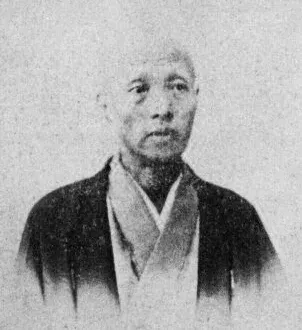
Unknown authorUnknown author · Public domain · via Wikimedia Commons

A Kyoto childhood京都・眞葛ヶ原
Miyagawa Kōzan was born Miyagawa Toranosuke on 15 February 1842 at Makuzugahara, below the Higashiyama hills of Kyoto, the fourth son of the potter Miyagawa Chōzō 宮川長造 (1797–1860), known as Makuzu Chōzō 真葛長造.[2][1] Chōzō had studied under the literati potter Aoki Mokubei 青木木米 (1767–1833) and, after Mokubei’s death, set up his kiln at Makuzugahara in the Gion district. Both of the family’s art names came from prince-abbots (monzeki) linked to the imperial house: “Makuzu” from Yasui no Miya, and “Kōzan” from Kachō no Miya of Chion-in.[1][3]
From the age of nine the boy studied painting with a local bunjinga (literati) painter, the future Taigadō IV of the Ike no Taiga line.[1][3] When his father and elder brother died in 1860 he inherited the family workshop at eighteen (nineteen by Japanese count) and took the name Kōzan, continuing Chōzō’s overglaze-enamelled earthenware, porcelain and tea wares.[2][8] 父と兄の死により十九歳で家督を継ぎ、初代香山を名乗った。His reputation grew quickly: in 1866 the shogunate commissioned him to make wares for presentation to the Imperial Palace.[2]
Bizen interlude備前・虫明
In the late 1860s Kōzan was invited to work elsewhere. An approach from Komatsu Tatewaki came to nothing, but in 1867 he accepted an invitation (the Kōsai family history dates it to 1868) from Igi Tadazumi (1818–1886) to work at the Igi family kiln at Mushiage, in present-day Oku-chō, Setouchi (Okayama). He spent about two years there making blue-and-white wares, years that coincided with the Meiji Restoration.[1][3][11]
Yokohama and the Makuzu kiln横浜・太田の眞葛窯
In 1870 Kōzan left for the newly opened treaty port of Yokohama at the invitation of Umeda Hannosuke 梅田半之助, a merchant interested in exporting Satsuma ware, with financing from Umeda’s brother-in-law Suzuki Yasubei 鈴木保兵衛.[1][2][3] The kiln opened in 1871 on a site of about 0.3 hectares at Nishiōta (today Kanoedai, Naka-ku) and took the name Ōta.[1][6] Yokohama had no ceramic tradition and the Kantō lacked good clay, so Kōzan prospected widely for materials. He brought four apprentices from Kyoto and by 1872 had overcome the first difficulties and taken on many local workers, men and women.[1][3]
The early output followed the gilded “Satsuma” style that foreign buyers wanted. Pollard accepts that, at least until 1876, there was some truth in Frank Brinkley’s charge that the workshop took part in the trade in new Satsuma distressed to pass as antique.[1][3] After a serious fire in 1876 Kōzan rebuilt at his own expense, freeing himself from the partnership; Suzuki later went bankrupt and Kōzan sold on his own account.[1][3]

Yurindo · Public domain · via Wikimedia Commons
Takaukibori: sculpture on the vessel高浮彫の創始
Satsuma’s heavy gold made it costly, and the outflow of gold was itself a concern. Kōzan’s answer was takaukibori 高浮彫, “high-relief carving”: realistic birds, animals and plants modelled in clay and applied to or carved from the body of the vessel, then coloured.[2][8] Hawks and pigeons, bears and cats, crabs, cherry blossom and grapes, oni and anthropomorphic frogs all appear.[1] He is said to have kept hawks and bears in his garden to study them from life.[2] single source
The ware, sold as Makuzu-yaki 眞葛焼 (also called Yokohama-yaki), won acclaim at the Philadelphia Centennial Exposition of 1876.[2][1] At the First National Industrial Exhibition in Tokyo in 1877 the Meiji Emperor touched one of his vases, a moment that made Kōzan famous.[1][4] The Bonhams 2024 catalogue adds that the piece was later bought for the Imperial collection and that Kōzan also won prizes at Vienna in 1873.[10] unverified — auction-house note only
The Footed Bowl with Crabs 褐釉蟹貼付台付鉢 (1881), shown at the Second National Industrial Exhibition and now in the Tokyo National Museum (G-105), was designated an Important Cultural Property on 26 June 2002. Two near life-size swimming crabs climb a deliberately distorted, brown- and straw-ash-glazed bowl; the Agency for Cultural Affairs calls it the only early-Meiji Kōzan work whose date and exhibition history are securely documented, through the TNM’s photograph album of the 1881 exhibition.[5][6]
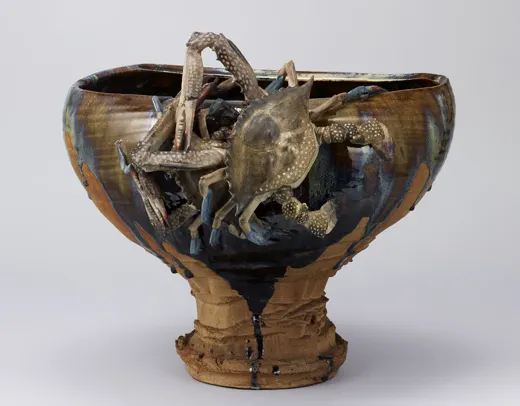
Tokyo National Museum · CC BY 4.0 · via Wikimedia Commons

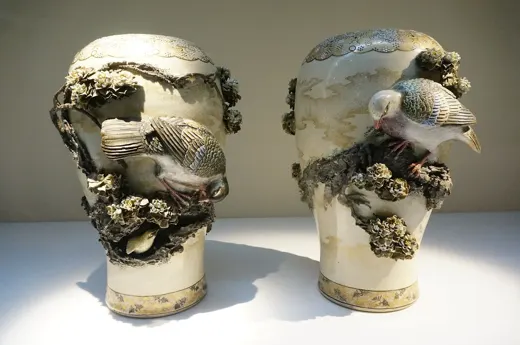
SLIMHANNYA · CC BY-SA 4.0 · via Wikimedia Commons

Photo © Christie's, via lot page; archival reference, not openly licensed

Photo © Bonhams, via lot page; archival reference, not openly licensed
Porcelain, glaze and underglaze colour釉薬と釉下彩の研究
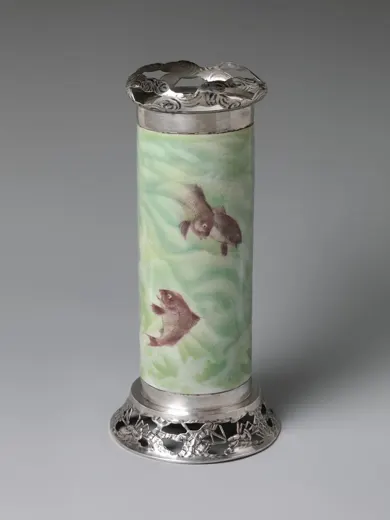
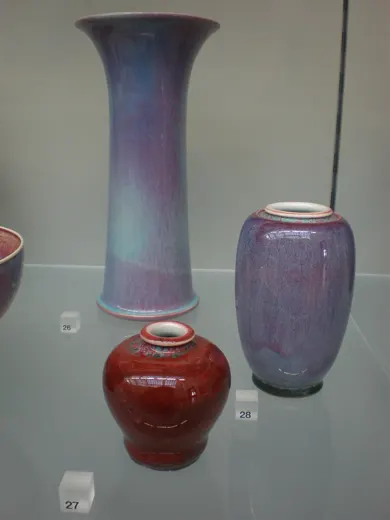
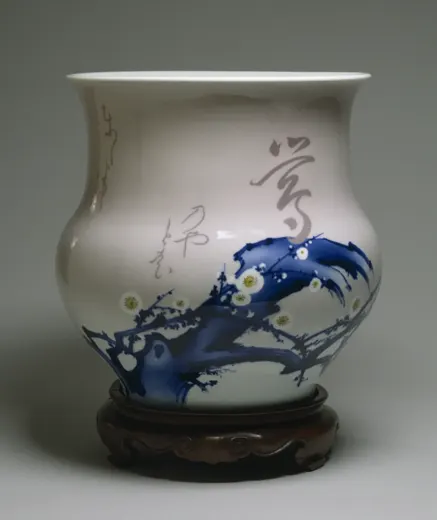
High relief was slow and costly to make, and the more refined it became the longer each piece took.[2] From the mid-Meiji 10s (c. 1880s) Kōzan turned to the study of glazes and underglaze colours modelled on Qing porcelain, and shifted his main production from earthenware to porcelain, leaving the kiln’s management increasingly to his adopted son Hannosuke.[8][2] In the 1890s he developed decoration combining several underglaze colours on one piece.[1][4] At the Paris Exposition Universelle of 1889 he won a gold medal for his yōhen (transmutation) glazes; at Chicago in 1893 the workshop received an honorary gold medal for a pair of elaborate stoneware vases.[1][4][3]
On 30 June 1896 Kōzan was appointed Teishitsu Gigei-in 帝室技芸員, Artist to the Imperial Household, only the second potter to receive the title.[7][8] At Paris in 1900, where Japanese ceramics generally fared poorly, he was the only Japanese ceramic grand prix winner, for a pair of large stoneware vases and a basin made with support from the Ministry of Agriculture and Commerce.[1][3]
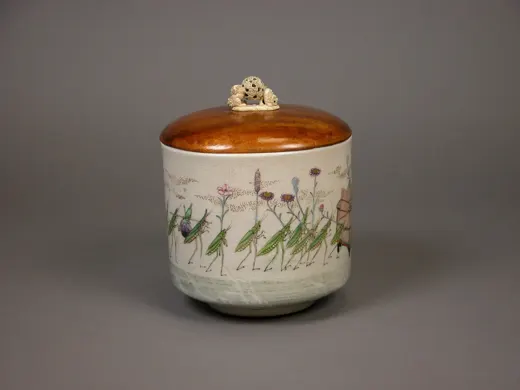
Makuzu Kozan · CC0 · via Wikimedia Commons

Makuzu Kozan · CC0 · via Wikimedia Commons

Makuzu Kozan · CC0 · via Wikimedia Commons

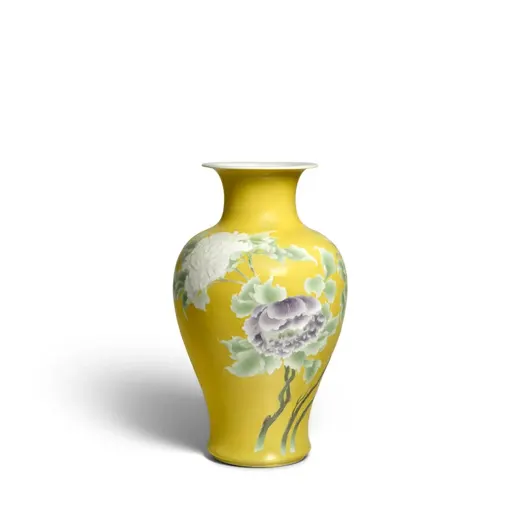
Photo © Bonhams, via lot page; archival reference, not openly licensed
Late work晩年
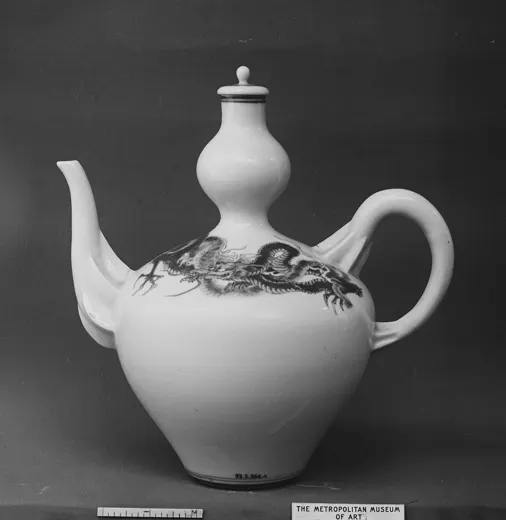
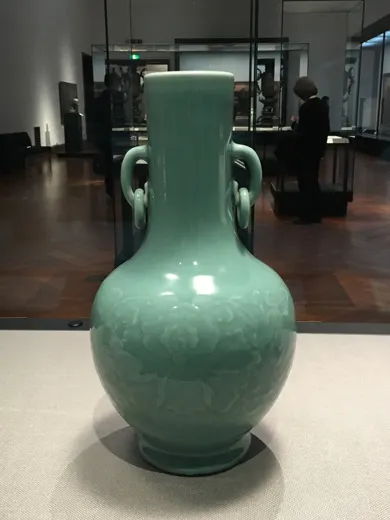
Between 1900 and 1910 the shapes and decoration of his work changed markedly under Western influence, Art Nouveau among them, towards flat, colourful, translucent designs; he also drew on Qing designs, especially dragons.[1][4][6] At the Japan–British Exhibition of 1910 a Kōzan vase was praised as “a perfect piece both artistically and technically”, and in 1911 the Imperial family commissioned a vase as a gift for the King of the Belgians.[1][4] Despite health and financial difficulties he kept experimenting with glazes until his death on 20 May 1916.[1][2] Between 1876 and 1913 he won prizes at 51 exhibitions.[1]

David Jackson · CC BY-SA 2.0 uk · via Wikimedia Commons

David Jackson · CC BY-SA 2.0 uk · via Wikimedia Commons

Makuzu Kozan · Public domain · via Wikimedia Commons


Jean-Pierre Dalbéra from Paris, France · CC BY 2.0 · via Wikimedia Commons

Legacy遺産
Because the ware was made for export, few pieces remained in Japan. From the late 1960s the collector Tanabe Tetsundo 田邊哲人 bought works back from abroad; his collection of modern export ceramics numbers around 3,000 pieces and formed almost the whole of the Suntory Museum of Art’s centenary retrospective (24 February–17 April 2016), which toured to the Museum of Oriental Ceramics, Osaka, and the Seto City Art Museum.[2][8] Yamamoto Hiroshi 山本博士 runs the Miyagawa Kōzan Makuzu Museum near Yokohama Station, holding about 600 works (as of February 2022).[2][9] Outside Japan the Khalili Collection holds more than eighty works.[1][4]
See Generations for Kōzan II–IV and the Kyoto Makuzu line, and the Chronology for a year-by-year record.
Gryffindor · CC0 · via Wikimedia Commons


Makuzu Kozan · CC0 · via Wikimedia Commons

Sources典拠
- Wikipedia (English), “Makuzu Kōzan”, en.wikipedia.org, accessed 23 Oct 2026.
- Wikipedia (日本語)「宮川香山」, ja.wikipedia.org, accessed 23 Oct 2026.
- Moyra Clare Pollard, Master Potter of Meiji Japan: Makuzu Kōzan (1842–1916) and His Workshop, Oxford University Press, 2002. ISBN 978-0-19-925255-8. (Cited via Wikipedia page references; not yet consulted directly.)
- Joe Earle, Splendors of Meiji: Treasures of Imperial Japan. Masterpieces from the Khalili Collection, Broughton International, 1999. ISBN 1874780137. (Cited via Wikipedia; not yet consulted directly.)
- 文化庁 国指定文化財等データベース「褐釉蟹貼付台付鉢〈宮川香山作/〉」, kunishitei.bunka.go.jp.
- ColBase / Tokyo National Museum, G-105, colbase.nich.go.jp; e国宝 emuseum.nich.go.jp.
- 『官報』第3901号, 1 July 1896 (cited in Japanese Wikipedia; original not yet consulted).
- 「没後100年 宮川香山」 Miyagawa Kozan Retrospective, Suntory Museum of Art, 24 Feb–17 Apr 2016; listing at NACT Art Commons and museum.or.jp (tour venues).
- 宮川香山 眞葛ミュージアム (Makuzu Museum), kozan-makuzu.com and guide.
- Bonhams, Fine Japanese and Korean Art, New York, 18 Sep 2024, lot 802, bonhams.com (catalogue footnote).
- 真葛 宮川香齋 (Makuzu Miyagawa Kōsai house, Kyoto), 「真葛の歴史・歴代当主」, makuzu-yaki.jp/ja/history, accessed 23 Oct 2026. Family-published source.